All Stories
- Animals
Rats can bop their heads to a musical beat
Rats’ rhythmic response to human music doesn’t mean they like to dance. But it may shed light on how brains evolved to perceive rhythm.
- Psychology
Procrastination may hurt your health — but you can change that
Scientists have linked procrastination to mental and physical health problems. But don’t be too hard on yourself — there are steps you can take.
- Ecosystems
Scientists Say: Food web
All the species in an ecosystem and the feeding relationships between them get summed up with this handy picture.
- Brain
Scientists mapped every nerve cell in this insect brain
Researchers have built a “connectivity map” of all the nerve cells in the larval fruit fly brain and how they link together.
- Earth
Under the ice, a hidden lake hints at its origin — and coming end
Lake Mercer may serve as a model for better understanding the birth and life of Antarctica’s hundreds of subglacial lakes.
- Earth
A natural ‘cathedral’ lurks deep under Antarctic ice
By drilling into this cavern, scientists have opened a window into the mysterious world of hidden lakes, their occupants — and rivers that run uphill.
- Health & Medicine
Humans might be able to hibernate during space travel
Scientists are studying how animals hibernate and developing new technologies to help humans sleep through space travel.
- Brain
Let’s learn about the science of language
The languages we speak may help shape how we see, smell and hear the world around us.
- Earth
One collision could have formed the moon and started plate tectonics
A hypothetical planet slamming into Earth 4.5 billion years ago might have set subduction into motion.
- Math
Scientists Say: Möbius strip
Möbius strips may be easy to make, but they have some pretty mind-bending properties.
- Planets
Research on exoplanets took top award at 2023 Regeneron ISEF
Six young researchers took home the top awards, each valued at a minimum of $50,000. Hundreds more shared nearly $9 million in prizes at international event.
- Plants
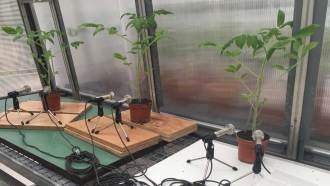
Analyze This: Plants sound off when they’re in trouble
When dry or cut, tomato and tobacco plants make sounds too high for humans to hear. Such sounds could provide a way to snoop on crops.