Questions for ‘What’s so noble about the Nobel Prize?’
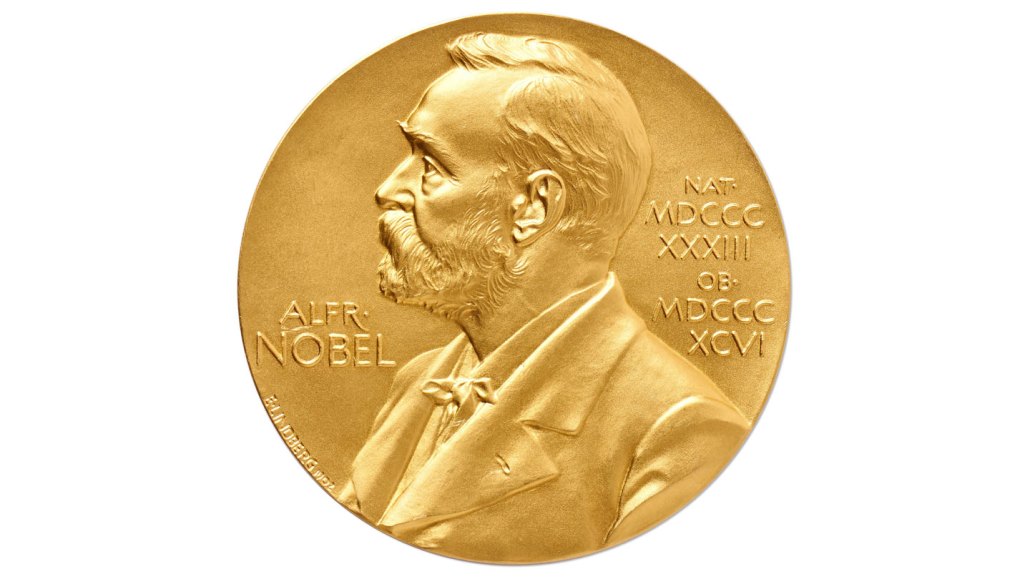
Every Nobel Prize winner receives a gold medal, which has the face of Alfred Nobel on one side, and a cash prize. Nobel Prizes honor discoveries in three scientific areas: chemistry, physics, and medicine or physiology.
Nate D Sanders/Bournemouth News/Shutterstock
Share this:
- Share via email (Opens in new window) Email
- Share on Facebook (Opens in new window) Facebook
- Share on X (Opens in new window) X
- Share on Pinterest (Opens in new window) Pinterest
- Share on Reddit (Opens in new window) Reddit
- Share to Google Classroom (Opens in new window) Google Classroom
- Print (Opens in new window) Print
To accompany ‘What’s so noble about the Nobel Prize?’
SCIENCE
Before Reading:
- What is a Nobel Prize? How often are they awarded, to the best of your knowledge? List three different fields that you think are awarded a Nobel Prize.
- What must a person do to get a Nobel Prize? If you hear that someone has won a Nobel Prize, what do you think that says about them? How do you think someone gets chosen to win a Nobel Prize?
During Reading:
- Explain the role of messenger RNA in a cell.
- How did Katalin Karikó’s work help people during the COVID-19 pandemic?
- List three fields awarded Nobel Prizes each year by the Nobel Foundation.
- What is the maximum number of people who can share a Nobel Prize?
- What field of science did Alfred Nobel work in?
- What was Nobel’s most famous invention?
- What was the headline of Nobel’s mistaken obituary?
- Which organization handles Nobel Prize nominations for two different fields?
- What year did Victor Ambros take home a Nobel Prize?
- Briefly describe some ways that winning the Nobel Prize changed how Ambros spends his time.
- Through 2024, how many women in total had been awarded a Nobel Prize?
- What does a sociologist study?
After Reading:
- Review the selection process for picking Nobel Prize winners, as described in this story. List two criticisms of the process mentioned here. Do you think the procedures for selecting Nobel Prize winners should be changed or remain as they are now? If you answered that they should change, describe one potential change that you think could improve some aspect of the selection process. If you answered that they should remain the same, elaborate on your answer by referring to and possibly countering the two criticisms you listed above. Despite these criticisms, why do you think the procedures should remain as they are today?
- There are no reports that Alfred Nobel ever said how he felt about reading his own (mistaken) obituary. Consider the circumstances of this obituary and speculate on how you might feel if you were in his place. To what extent do you think this event played a role in this scientist’s later decision to fund what would become the Nobel Prizes? If the two events are connected — the published obituary and the creation of the prizes — what reasons might he have had for taking this course of action?
- Consider possible explanations for why members of some groups of people win Nobel Prizes more often than others. Besides potential bias during the nomination and selection process, what are some other reasons that fewer women and people of color have won Nobel Prizes compared with men and white people? Do these rational explanations mean that bias never affects the selection process? Explain your answer. Does the existence of these rational explanations make it easier, make it harder or have no effect on the ability to identify and curb bias in the selection process?