Earth's Place in the Universe
- Space
Analyze This: A recently spotted space object is puzzling scientists
A pulsar’s invisible partner could be an oddly heavy neutron star or a very light black hole.
- Space
Comets may be the source of sandy dunes on Saturn’s largest moon
In an early reshuffling of the solar system, comet collisions and other space rocks could have sent dusty bits falling to Titan’s surface.
- Space
Check out the magnetic fields around our galaxy’s central black hole
Astronomers have captured polarized light coming from the Milky Way’s supermassive black hole. This offers insight into its magnetic fields.
- Space
Explainer: What is the solar cycle?
Here’s what causes the sun’s 11-year cycle of activity and what it means for us on Earth.
- Space
Scientists Say: Corona
The sun’s corona can only be seen without special instruments during a total solar eclipse.
- Physics
Forests could help detect ‘ghost particles’ from space
If trees could act as natural antennas, one physicist proposes that they just might pick up signals of hard-to-spot ultra-high energy neutrinos.
- Earth
Get ready for the 2024 total solar eclipse
A total solar eclipse will race across North America on April 8, 2024, providing a rare opportunity for both scientists and casual observers.
- Space
Let’s learn about meteorites
Meteorites are bits of space rock that have crash-landed on Earth — or on another celestial body.
- Space
Scientists Say: Solar Cycle
This roughly 11-year cycle in the sun’s activity can affect space weather that messes with Earthly technology.
- Earth
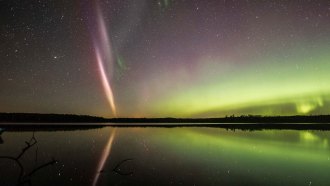
The weird sky glow called STEVE is really confusing scientists
Researchers are trying to figure out the recipe of atmospheric conditions that creates this aurora-like light show.
- Space
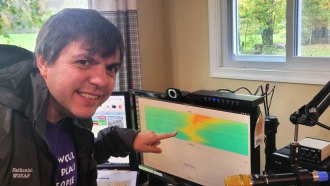
This space physicist uses radios to study eclipses
Nathaniel Frissell uses radio data to study how eclipses affect a layer of the atmosphere called the ionosphere.
- Planets
Huge polygons on Mars hint its equator may once have been frozen
A Chinese rover used radar to reveal long-buried terrain. The discovery hints that Mars’ equator was once much colder and wetter.