MS-ETS1-1
Define the criteria and constraints of a design problem with sufficient precision to ensure a successful solution, taking into account relevant scientific principles and potential impacts on people and the natural environment that may limit possible solutions.
- Humans
Common high-school textbooks promote unscientific views on gender
Inaccurate descriptions of sex and gender may lead to sexism or prejudice toward people who don’t seem to represent gender norms.
- Physics
Aerodynamics involved in shooting hoops can make vehicles greener
Some ships host tall spinning cylinders that act like sails. Roughing the cylinders’ surface will greatly boost fuel efficiency, teen scientists find.
- Materials Science
A bit of electricity can glue hard metals to soft materials
Using this method to stick and unstick metals from soft materials could one day create new types of batteries.
- Tech
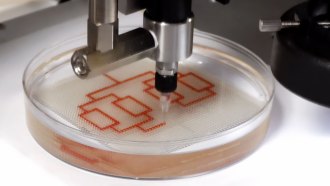
Lego bricks inspired a new way to shape devices for studying liquids
Inspired by Lego building blocks, the approach could enable design of adaptable tools to study how fluids move through very small spaces.
- Materials Science
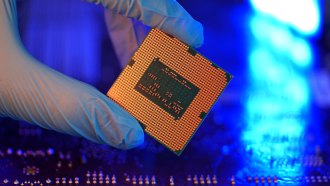
Scientists Say: Semiconductor
Modern electronics, from cell phones to video games, work thanks to these conductor-insulator hybrids.
- Tech
Scientists Say: Digital Footprint
Your digital footprint contains both what you post online — and information about your online activity collected by others.
- Artificial Intelligence
‘Jailbreaks’ bring out the evil side of chatbots
Researchers break chatbots in order to fix them. This so-called red-teaming is an important way to improve AI’s behavior.
- Chemistry
Turning jeans blue with sunlight might help the environment
When dipped in indican and exposed to sunlight, yarn turns a deep blue. This process is more eco-friendly than the current denim dyeing method.
- Artificial Intelligence
A new tool could guard against deepfake voice scams
Scammers can use AI to create deepfake mimics of people’s voices. AntiFake could make that type of trick much harder to pull off.
- Earth
Experiment: Can plants stop soil erosion?
Soil erosion washes pollutants into streams and rivers — but plants may help limit that.
- Tech
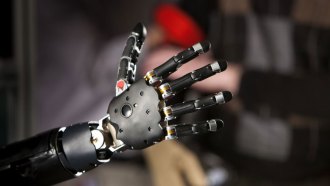
Scientists Say: Bionic
This type of technology combines natural and synthetic systems. It can restore lost vision and mobility and even grant cells new abilities.
- Tech
Could we build a mecha?
In the movies, mechas come equipped with all kinds of abilities. But real giant robots would first have to master simpler actions, like walking and jumping.