MS-PS1-6
Undertake a design project to construct, test, and modify a device that either releases or absorbs thermal energy by chemical processes.
- Materials Science
Self-powered surface may evaluate table-tennis play
Scientists at the Georgia Institute of Technology built a 'smart' surface on which to play table tennis. It can track the location, speed and direction of the ball.
- Physics
Here’s how quantum mechanics lets heat cross a vacuum
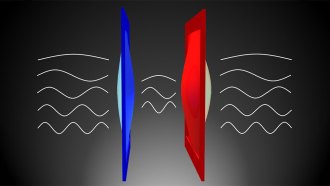
Heat can move across a vacuum if the span is small enough. As in really, really small. In a new experiment, the gap was only a few hundred nanometers.
- Materials Science
The future of crystal-based solar energy just got brighter
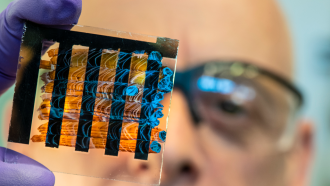
Researchers have upped the efficiency of layered solar cells that could be printed or painted onto surfaces. Now they are working to make them more rugged.
- Chemistry
Hard-to-burn ‘smart’ wallpaper even triggers alarms
Scientists have made wallpaper that won’t easily burn. And embedded nanowires can be linked to a sensor to sound an alarm when the paper gets too hot.
- Materials Science
Teen’s invention could help light up bikes at night
A teen researcher from Georgia has developed a light that could replace reflectors on bike wheels. Flexing tires provide all the power it needs.
- Animals
Cool Jobs: A world aglow
Three scientists probe how the natural world makes light, in hopes of using this information to design new and better products.
- Materials Science
Cool Jobs: Big future for super small science
Scientists using nanotechnology grow super-small but very useful tubes with walls no more than a few carbon atoms thick. Find out why as we meet three scientists behind this huge new movement in nanoscience.
- Physics
World’s coolest ‘clock’ is also crazy-accurate
This is the time to beat — the world’s most accurate atomic clock ever. At its heart is a ‘fountain’ of cesium atoms chilled nearly to absolute zero!
- Physics
Temperature ‘lock’ for new hard drives?
A novel material can alter how easy it is to change data stored on it, based on temperature. One immediate application: more secure hard drives for computing.
- Physics
Closing in on fusion energy
Scientists blasted a tiny capsule of hydrogen with laser beams, setting off a reaction that released more energy than in earlier experiments. Still, scientists remain a long way from creating a reaction that releases more energy than it needs to get started.