Chemistry
- Plants
Young corn leaves can ‘smell’ danger
As they mature, these leaves lose their ability to detect threatening scents.
- Climate
Hydrogen energy could help our climate — depending on its source
Hydrogen energy doesn’t emit greenhouse gases when it’s used. But how it’s produced will affect how useful it can be in slowing climate change.
- Tech
Explainer: The hydrogen rainbow
Hydrogen works the same, regardless of its source. But how clean or “green” it is very much hinges on its color-coded name — which points to how it was made.
- Tech
Engineers cook up a new way to tackle CO2: Make baking soda
Engineers have found a material that can collect carbon dioxide from the air. When later mixed with water, it forms baking soda that can be shed in the sea.
- Chemistry
Scientists turn plastic wastes into soap
Chemists developed a way to turn plastic waste into surfactants. Those chemicals could one day become key recruits in a greener war on grime.
- Chemistry
Scientists Say: Lignin
This rigid polymer transports water and gives trees their strength.
- Environment
Ultrasound waves can help remove polluting microplastics in water
The innovative process concentrates microplastics within a flowing liquid. A two-step process then removes the potentially toxic bits.
- Chemistry
Experiment: Kimchi chemistry
In this cooking and food science project, we make kimchi from scratch and investigate changes in pH and glucose as it ferments.
- Physics
Scientists Say: Supercool
When a liquid is supercooled, it has been chilled below its freezing point without freezing.
- Chemistry
Creation of quantum dots wins 2023 chemistry Nobel
The award honors three scientists who discovered and built quantum dots, which are now used in everything from TVs to medical tools.
- Chemistry
Scientists Say: Rare earth element
Rare earth elements aren’t all that rare — but skyrocketing demand for these metals makes them precious.
- Animals
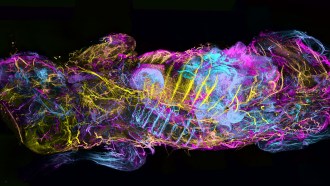
A new technique creates glowing whole-body maps of mice
Removing cholesterol from mouse bodies lets fluorescent proteins seep into every tissue. That has helped researchers map entire body parts.