Physics
- Environment
‘Mining’ cryptocurrencies pollutes the real world
Bitcoin and other cryptocurrencies exist only online. Yet the environmental impacts of their networks affect the real world.
- Environment
How we choose to pay has hidden costs for the planet
Whether cash or credit, phone apps or digital currencies — all forms of payment have behind-the-scenes costs. And these can vary dramatically.
- Physics
Explainer: How do mass and weight differ?
Learn why these terms aren’t the same and which to use where. And should you report your results in kilograms? Pounds? If in doubt, try using newtons.
- Math
Why some icicles become scallops not spikes
The newfound — and at times quirky — shapes reflect the density of water surrounding submerged ice.
- Physics
Wild art? No, it’s a radio image of the heart of our Milky Way
Eyelash-like radio filaments accent the brightest feature in this image — a supermassive black hole.
- Chemistry
Clothes dryers may be a major source of airborne microplastics
Scientists thought washing machines were a leading contributor of microplastics. Now it appears dryers may be an even bigger problem.
- Physics
Analyze This: Masks cut the distance that spit droplets fly
Both cloth masks and surgical masks reduced the distance spit traveled from a person talking or coughing by at least half, compared with no mask.
- Environment
Explainer: Gravity and microgravity
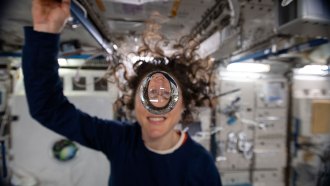
The force of gravity holds us on the ground, keeps planets in orbit and extends throughout space. A very weak gravitational pull is called microgravity.
- Chemistry
Scientists Say: Decay
This word can refer to rotting flesh or the transformation of radioactive atoms.
- Physics
Scientists Say: Voltage
Voltage is a measure of how much electricity is available to power devices.
- Materials Science
Let’s learn about glass
Unlike the atoms in other solids, the atoms in glass don’t exist in an orderly crystal structure. They’re more jumbled up, like the atoms inside liquids.
- Tech
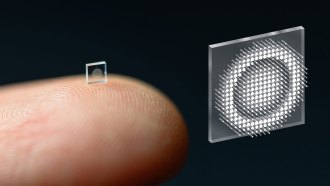
This crumb-sized camera uses artificial intelligence to get big results
Researchers have developed a camera the size of a coarse grain of salt that takes amazingly clear photos.