HS-LS1-2
Develop and use a model to illustrate the hierarchical organization of interacting systems that provide specific functions within multicellular organisms.
- Science & Society
Large numbers of underage kids are on social media, study finds
Two in every three kids aged 8 to 12 have already been on social media, and one-tenth have been bullied there. Some kids report other bad experiences too.
- Animals
A bonobo’s imaginary tea party hints that apes can pretend
Kanzi would sometimes play with imaginary juice and grapes, just as humans might. The bonobo's ability challenges old ideas about how animals think.
- Animals
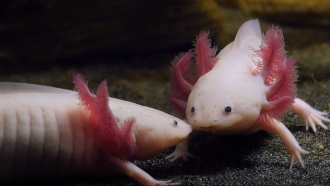
Let’s learn about animals that can regrow body parts
Animals that regenerate limbs, eyes and other body parts may hold clues to superhuman healing.
- Brain
Adolescence appears to last far longer than once thought
The brain undergoes “rewiring” throughout adolescence and doesn’t reach its adult architecture until our early 30s, suggests a new study.
- Health & Medicine
Scientists Say: Symptom
A runny nose, fever or feeling of fatigue might clue your doctor in to the right diagnosis.
- Animals
As toddlers, chimps are major risk takers
Human kiddos are generally too closely supervised to be able to monkey around as much as young chimps. Instead, older kids — teens — are usually the bigger risk takers.
- Plants
Scientists Say: Pollination
Plants call upon wind, water or helpful animals to carry out this crucial step of their life cycle.
- Humans
Using physics can help athletes avoid sports injuries
Jessica Talmage uses physics to help understand how the body moves. Her findings help athletes avoid sports injuries and improve their performance.
- Chemistry
Explainer: What is chirality?
Chiral molecules are mirror images of each other. They might not seem all that different — but can have drastically different effects in medicine, materials and more.
- Brain
Scientists Say: Hallucination
Humans are not the only ones who can hallucinate. When a chatbot confidently generates a plausible but incorrect response, this error is called a hallucination.
- Psychology
Everyone experiences malicious joy now and then
Called schadenfreude, feeling happy when we see someone else’s pain is typically harmless. But unchecked, it can have big consequences.
- Artificial Intelligence
Chatbots may make learning feel easy — but it’s shallow
People who use search engines gain deeper knowledge and care more about what they learn than those who rely on AI chatbots, a new study finds.