Fossils
New clues about dino speed come from birds strutting through mud
Fossilized footprints can help calculate how fast dinosaurs moved. But tests with guinea fowl show that past estimates might not be right.
Come explore with us!
Fossilized footprints can help calculate how fast dinosaurs moved. But tests with guinea fowl show that past estimates might not be right.
The extinct megalodon (Otodus megalodon) was the largest shark to ever prowl the oceans.
Supercomputing and AI cut the early discovery steps from decades to just 80 hours. The process led to a new solid electrolyte.
Microscopic fossils from Australia suggest that some bacteria evolved structures for oxygen-producing photosynthesis by 1.78 billion years ago.
At first, this hedgehog was mistaken for a lookalike relative. But its teeth, skull shape and DNA confirmed it as a new species.
The reptiles’ horns could help or hinder during foraging, depending on how they hunt. This might be why horns evolved in some species and not others.
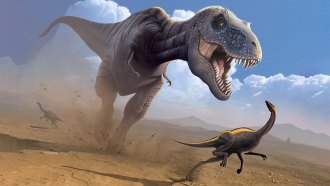
Dinosaurs like Tyrannosaurus have long been portrayed with their big teeth bared. But new research suggests this wasn’t so.
A new look at an ancient sea animal called Essexella suggests it may have been a type of burrowing sea anemone, not a floating jelly.
A nose-picking aye-aye’s spindly middle digit probably pokes all the way into the back of the throat, CT scans show.
Alexis Mychajliw’s science is driven by her love of animals. She now looks to tar pits and fossilized poop to understand ancient ecosystems.