Physics
- Chemistry
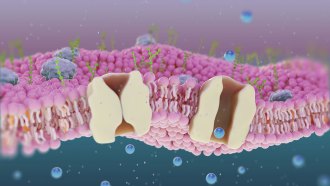
Explainer: How cells use chemistry to make the electricity of life
Charged particles, or ions, constantly move in and out of cells. These migrations produce tiny electric currents, which power your brain, heart and more.
- Physics
Weirdly, mayo can help study conditions ripe for nuclear fusion
Yes, mayo. The texture of the sandwich spread is perfect for mimicking what a fusion fuel capsule goes through when blasted with lasers.
- Physics
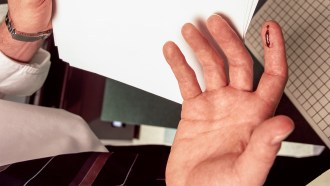
Science reveals the reasons behind painful paper cuts
Some types of paper are more likely to cause paper cuts. It’s the paper’s thickness and slicing angle that matter, physicists conclude.
- Space
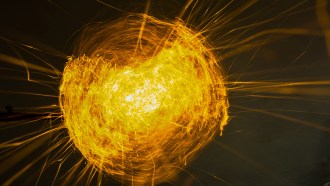
Scientists Say: Kugelblitz
A black hole made of pure light —or kugelblitz — may be possible, at least in theory. But in practice: impossible.
- Physics
Experiment: Making music with bottles
In this study, we investigate how the volume of air inside a bottle affects the pitch of the musical notes it can create.
- Physics
Scientists Say: Magnetosphere
This magnetic field encapsulates our planet, sheltering us from damaging energetic threats posed by the cosmos and our own sun.
- Space
Scientists Say: Cosmic rays
These energy-packed particles come to us from the farthest reaches of outer space.
- Chemistry
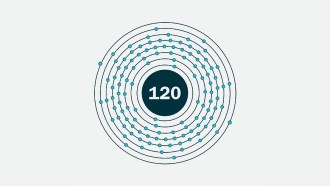
The periodic table might soon have a new element
A new technique could be used to make the undiscovered element 120.
- Tech
Lasers help put the cork on spilled oil
Treating cork with lasers made the material able to quickly sponge up oil while repelling water, scientists in China and Israel found.
- Materials Science
Scientists Say: Goldene
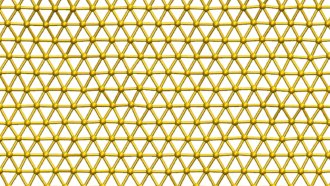
Making this metallic, two-dimensional (2-D) material is difficult — but super-thin sheets of gold could have uses in electronics and chemistry.
- Science & Society
Scientists Say: Thought experiment
Thinking through imaginary, sometimes absurd, scenarios can catalyze new ways of thinking.
- Tech
Laser-based tech can identify illegal elephant ivory
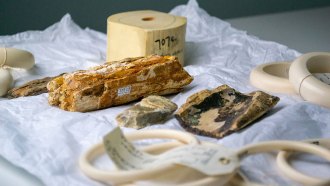
Most elephant ivory is illegal to sell. Ivory from extinct mammoths isn’t. They look similar, but lasers can tell the difference to help catch poachers.