Physics
- Earth
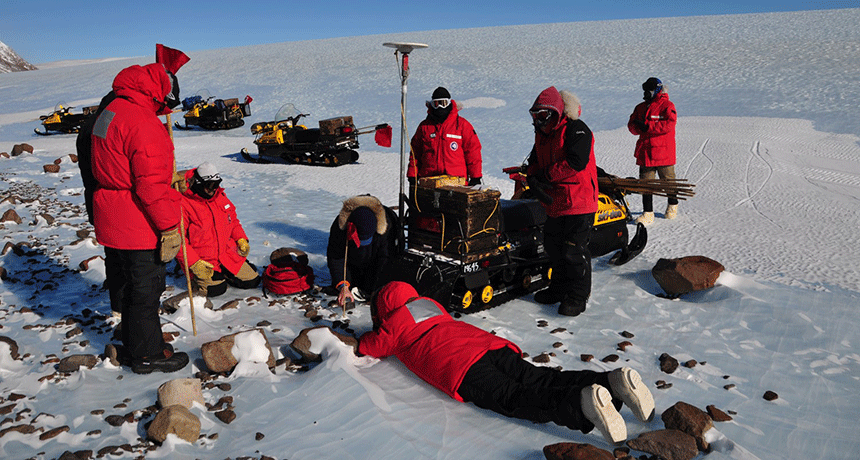
Hot on the trail of Antarctic meteorites
For intrepid scientists, spotting meteorites against Antarctica’s dazzling whiteness is easy. Then what?
- Health & Medicine
New treatment could calm temperature-sensitive teeth
Dentists aren’t happy with today’s treatments for sensitive teeth. Sand-like nanoparticles carrying green tea extract could bring longer pain relief.
- Materials Science
Want a tougher space suit? Just add liquid
Using a special liquid, engineers are designing new treatments for spacesuits so that they can better resist puncturing from tiny meteorites and other hazards.
- Physics
Scientists Say: Laser
A laser is a device that emits a strong, narrow beam of light. “Laser” is actually an acronym, and stands for “light amplification by stimulated emission of radiation.”
- Microbes
Magnetic heating may replace surgery to cure some infections
Scientists are testing magnetic fields as a way to kill bacteria that drugs normally cannot reach — such as those on medical implants inside the body.
- Animals
Lasers can turn a spider’s silk into sculptures
Spider silk is strong and super-stretchy. Scientists have developed a way to sculpt that material into unusual, micro-scale shapes using lasers.
- Archaeology
Scientists detect mystery void in Great Pyramid of Giza
Using high-tech tools normally reserved for studies in particle physics, scientists have found a large, hidden void inside Egypt’s Great Pyramid of Giza.
- Physics
Ancient light may point to where the cosmos’ missing matter hides
The universe is missing some of its matter. Now astronomers may have a way to find it.
- Physics
Teen identifies way to detect failing underground pipes
A teen researcher uses acoustics — here, pipe vibrations — to test whether buried water pipes are about to fail, and leak.
- Genetics
One day, your sunscreen may be made from DNA
A new approach to sunscreen could use a thin layer of DNA to protect skin cells — and hopefully prevent cancer.
- Materials Science
You can peel permanent marker, intact, off of glass
The surface tension of water can essentially scrape a thin film of some water-repellent material — such as permanent ink — off of glass.
- Chemistry
Scientists Say: Gradient
This is a word used to describe the rate that something changes over a distance or time. Examples include the strength of a smell or the steepness of a mountain.