All Stories
- Chemistry
Scientists Say: Element
The number of neutrons and electrons can vary in atoms of the same element. The number of protons alone sets each of these substances apart.
- Humans
These Korean women spend more time underwater than any other humans
At an average age of 70, these divers in South Korea still forage in the sea for up to 10 hours a day. They spend more than half of that time underwater.
- Physics
How to make a pitched ball curve to your will
A range of tricks pitchers use to get curve all come down to the thin layers of air next to the ball — and how a ball’s spin and seams affect them.
- Earth
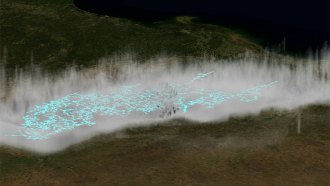
This ‘megaflash’ is now the longest lightning bolt on record
A reanalysis of satellite data showed that a 2017 Texas-to-Missouri lightning megaflash stretched 829 kilometers (515 miles) and lasted 7.39 seconds.
- Space
Looking for aliens from the far side of the moon [COMIC]
Earth’s noise and light pollution can make it hard to detect signs of life on other planets. The solution? Telescopes that use the moon as a shield.
- Plants
Physics explains how rose petals get their iconic shape
Scientists thought they knew what was behind rose petals’ geometry. They were wrong.
- Math
Scientists Say: Quantitative and Qualitative
These two research approaches collect different forms of data. Both help scientists unlock secrets and build knowledge.
- Humans
Forget droplets. Here’s how sweat really forms
This is the most detailed look yet at how we perspire. Beads of sweat are out, puddling is in.
- Animals
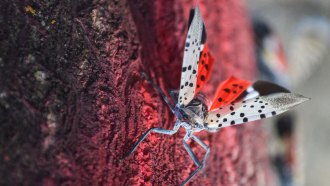
Quashing the spotted lanternfly may require help from other species
This invasive pest has spread to 17 U.S. states and may threaten vineyards. But bats, fungi, dogs and even trees may help halt the lanternfly's spread.
- Animals
What dogs see on TV depends on their temperament
Breed, age or sex didn’t seem to matter in how dogs reacted to TV, but personality did. That’s according to a survey of more than 400 dog owners.
- Earth
Let’s learn about rivers
Rivers vary a lot in size and terrain, but all share a few basic features.
- Archaeology
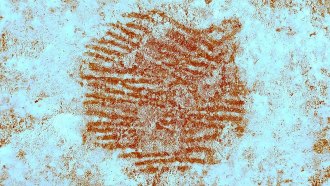
This may be the oldest, most complete Neandertal fingerprint ever seen
The print appears in a red ochre dot, which a Neandertal left on the ‘nose’ of a facelike rock roughly 43,000 years ago.