All Stories
- Climate
An ancient log shows how burying wood can fight climate change
A blanket of clay soil helped the wood hold onto the carbon it had absorbed — for thousands of years.
- Physics
Let’s learn about entanglement
Entanglement is a special connection between particles that syncs up their properties — even when the particles are far apart.
- Tech
This young engineer built an affordable electronic braille reader
Thermo Fisher JIC finalist Yash Mehta got inspired to make a better braille device after visiting a school for blind students in Old Delhi, India.
- Planets
Scientists Say: Theia
Clues about this ancient protoplanet's catastrophic end may have been entombed in Earth's lower mantle for billions of years.
- Science & Society
Our brains might help explain why people disagree on politics
Differing political views may stem from our evolutionary past — and show up in distinct brain activity. Knowing this may help with challenging discussions.
- Brain
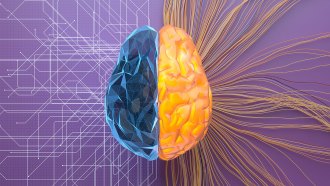
Why we aren’t really ‘left-brained’ or ‘right-brained’
The idea that we use different sides of the brains to be creative or logical is popular — but it’s not supported by science. Here’s why.
- Space
Why are scientists suddenly interested in UFOs?
For decades, science mostly ignored UFOs. Then in 2015 Navy pilots started reporting them. The U.S. government enlisted scientists to investigate.
- Archaeology
An Egyptian mummy’s silent ‘scream’ hints at her violent death
A rare muscle stiffening known as a cadaveric spasm might explain the mummy’s open-mouthed expression.
- Earth
Thunderstorms churn up a ‘boiling pot’ of high-energy gamma rays
A thunderstorm seen in gamma ray vision plays out as a complex, frenzied lightshow above the clouds.
- Science & Society
Scientists Say: Dialect
Different dialects of the same language have distinct words, pronunciations and sentence structures.
- Animals
Werewolves could learn from other critters when to hunt
Werewolves aren’t the only creatures that undergo transformation under the full moon. But could weak werewolves be at risk of becoming prey?
- Animals
How to make ‘worms’ more nutritious — and easier to swallow
Extracting protein from insect larvae could lead to a healthful food ingredient — and you never have to bite into crunchy legs or squishy bodies.