Waves and Their Applications in Technologies for Information Transfer
- Physics
Let’s learn about particles that help us peer inside objects
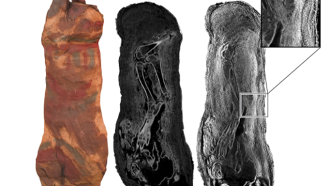
Particles such as muons, X-rays and neutrons help scientists peer inside fossils, mummies, pyramids, volcanoes and the human body.
- Space
Check out the magnetic fields around our galaxy’s central black hole
Astronomers have captured polarized light coming from the Milky Way’s supermassive black hole. This offers insight into its magnetic fields.
- Earth
Earthquake sensor: Taylor Swift fans ‘Shake It Off’
Scientists determined dancing fans were behind the seismic waves recorded during Swift’s August concerts.
- Physics
Forests could help detect ‘ghost particles’ from space
If trees could act as natural antennas, one physicist proposes that they just might pick up signals of hard-to-spot ultra-high energy neutrinos.
- Earth
Explainer: Sprites, jets, ELVES and other storm-powered lights
Fleeting glows collectively known as “transient luminous events” flash in the skies above powerful lightning storms.
- Physics
Here’s why blueberries aren’t blue — but appear to be
Blueberries actually have dark red pigments — no blue ones — in their skin. Tiny structures in the fruits’ waxy coat are what make them seem blue.
- Oceans
Analyze This: Climate change may worsen the spread of ocean noise
Some parts of the ocean may become five times as loud in the future.
- Earth
The weird sky glow called STEVE is really confusing scientists
Researchers are trying to figure out the recipe of atmospheric conditions that creates this aurora-like light show.
- Space
This space physicist uses radios to study eclipses
Nathaniel Frissell uses radio data to study how eclipses affect a layer of the atmosphere called the ionosphere.
- Physics
Physics explains why poured water burbles the way it does
The loudness of falling water depends on the height of the pour and the thickness of the stream.
- Physics
Scientists Say: Polarized light
Sunlight, lamplight and other lights are usually unpolarized. But passing light waves through filters can ‘polarize’ them.
- Physics
Neutrons are unveiling hidden secrets of fossils and artifacts
Images made with these particles have revealed details of dinosaur bones, mummies and more.