Space
- Science & Society
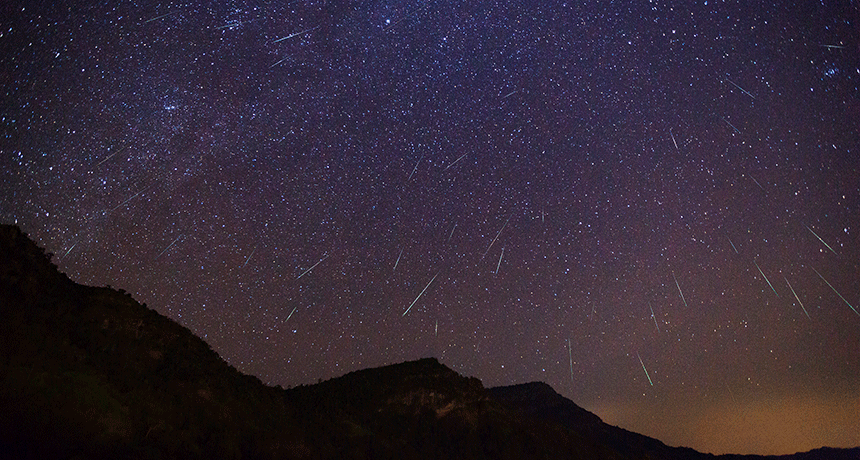
Catch a ‘shooting star’ this month — and most others
The Geminid meteor shower is underway. Here’s how you can enjoy this amazing show in the night sky.
- Planets
Quake-scouting lander safely touches down on Mars
NASA’s InSight lander has just arrived safely on the Martian surface. Its two year mission is to record any ‘Marsquakes’ and other signs of the planet’s geologic activity.
- Space
Scientists Say: Orbit
An orbit is the path one object in space takes around another, such as a planet, star or the center of an atom.
- Tech
Prepping for drone exploration of Mars
Twelve-year-old James Fagan, a budding engineer from Riverside, Calif., has built a wind tunnel. He uses it to test scale models of drones and other vehicles under Mars-like conditions.
- Physics
Scientists Say: Multiverse
The multiverse is an idea that there are many universes out there, including the one we live in. Each universe has an alternate reality.
- Space
R.I.P. Kepler, the planet-hunting telescope
It’s lights out for this spacecraft, after finding more than 2,700 exoplanets throughout our galaxy.
- Physics
Only a small fraction of space has been searched for aliens
In their hunt for extraterrestrial intelligence, SETI searches have only scouted an area the equivalent of a hot tub out of Earth’s oceans, a new calculation indicates.
- Space
The movie ‘First Man’ captures early spaceflight’s terror
At a time when NASA is considering how to once again send people to the moon, ‘First Man’ is a sobering reminder of how risky the first giant leap was.
- Planets
Hubble may have spotted a possible ‘exomoon’
The apparent moon would be the size of Neptune and orbit a distant gas-giant planet known as Kepler 1625b.
- Space
Cool Job: Making stellar connections
Astrophysicist Paula Jofré wants to find links between all the stars in our galaxy, the Milky Way.
- Space
Scientists Say: Yellow dwarf
Yellow dwarf is a term used for a medium-sized star. Our sun is a yellow dwarf.
- Physics
Distant galaxy seems filled with dark matter
If the Cosmic Seagull is a repository for dark matter, it will be the most distant galaxy to be filled with mysterious stuff.