Matter and Its Interactions
- Materials Science
Self-powered surface may evaluate table-tennis play
Scientists at the Georgia Institute of Technology built a 'smart' surface on which to play table tennis. It can track the location, speed and direction of the ball.
- Physics
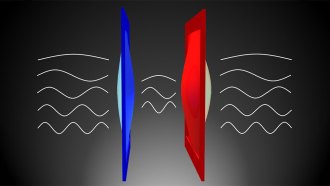
Here’s how quantum mechanics lets heat cross a vacuum
Heat can move across a vacuum if the span is small enough. As in really, really small. In a new experiment, the gap was only a few hundred nanometers.
- Materials Science
The future of crystal-based solar energy just got brighter
Researchers have upped the efficiency of layered solar cells that could be printed or painted onto surfaces. Now they are working to make them more rugged.
- Chemistry
Like Magneto? Microcrystals give magnets superpower over living cells
New iron-rich protein crystals could help researchers better understand the nerve cells that control movement and sensation. All they need are magnets.
- Chemistry
Chemistry’s ever-useful periodic table celebrates a big birthday
2019 is the International Year of the Periodic Table. But the traditional chart is just one of many shapes that chemists and other scientists have developed to organize the elements.
- Chemistry
Explainer: What are acids and bases?
These chemistry terms tell us if a molecule is more likely to give up a proton or pick up a new one.
- Earth
Explainer: Understanding geologic time
Geologic time is unimaginably long. Geologists puzzle it out using a calendar called the Geologic Time Scale.
-
- Climate
Explainer: Why sea levels aren’t rising at the same rate globally
The ocean is rising all over the world. The rise seems speedier in some places. What gives? Many factors, it turns out, affect where — and why — the tide gets high.
- Chemistry
Explainer: How is water cleaned up for drinking
Unless you’re drinking well water, city folks typically get drinking water that has been treated in a water-treatment plant. Here’s what that means.
- Climate
Explainer: Where fossil fuels come from
Despite one oil company famously using an Apatosaurus as its logo, oil, gas and coal don’t come from dinosaurs. They do, however, come from a long time ago.
- Earth
Explainer: CO2 and other greenhouse gases
Carbon dioxide is just one of several chemicals that contribute to the greenhouse effect. Nitrous oxide, methane and CFCs are other big contributors.